CALIFORNIA · SUPPLEMENTAL PRACTICE
California Class C core practice
Loading practice. If it does not load, enable JavaScript or use the study guide. Study all 60 questions, answers and sources below.
Study all 60 questions, answers and sources
This guide shows answers before an attempt is finished. Independent supplemental California adult English Class C practice; not an official DMV test or blueprint, and not a prediction of readiness or results.
Questions, answers and explanations
Signs and signals
A signal is dark at an intersection after a power outage. What should you do?
- Treat the intersection as an all-way stop and proceed only when safe. (correct): Correct: treat the dark signal as a stop sign, then proceed safely.
- Continue through because a dark signal gives your direction priority.: A dark signal does not grant priority to any approach.
- Wait for a traffic officer even if none is present.: The cited rule does not require waiting indefinitely for an officer.
A nonworking signal is treated as a stop sign at each approach. Stop, then proceed cautiously under right-of-way rules.
Source: California Driver’s Handbook, Section 7: Laws and Rules of the Road — Section 7, Traffic Control / Traffic Signal Lights / Nonworking Signals
You face a steady red arrow in the direction you want to turn. What is the safe legal action?
- Turn after stopping if the crosswalk is empty.: A stop does not make a turn against a red arrow permissible.
- Stop and wait for a green signal or green arrow. (correct): Correct: wait for a green indication.
- Proceed if cross traffic has stopped.: Stopped cross traffic does not change the red-arrow instruction.
A red arrow prohibits the indicated movement until a green indication appears. A red-arrow exception is not the same as a permitted right turn on a solid red circle.
Source: California Driver’s Handbook, Section 7: Laws and Rules of the Road — Section 7, Traffic Control / Traffic Signals / Red Arrow
A red signal is a solid circle, with no sign prohibiting a right turn. What must happen before a right turn?
- Slow down and turn if no vehicle is close.: Slowing without stopping is insufficient.
- Wait for green because right turns on red are never allowed.: The handbook permits a right turn on a solid red circle when conditions allow.
- Come to a complete stop, yield, then turn only when safe. (correct): Correct: stop fully, yield, and turn only if safe.
California permits a right turn at a solid red circle unless prohibited, but the driver must first stop and yield to pedestrians and conflicting traffic.
Source: California Driver’s Handbook, Section 7: Laws and Rules of the Road — Section 7, Traffic Control / Traffic Signals / Solid Red Light
A red octagonal sign stands before a crosswalk, with no painted stop line. Where do you stop?
- Before entering the crosswalk. (correct): Correct: stop before entering the crosswalk.
- With the front wheels just inside the crosswalk.: Stopping in the crosswalk puts the vehicle into the pedestrian space.
- At the far side of the intersection.: The stop must occur before the crosswalk, not after crossing the intersection.
A stop sign requires a full stop before the crosswalk; when neither a limit line nor crosswalk exists, stop before the intersection.
Source: California Driver’s Handbook, Section 7: Laws and Rules of the Road — Section 7, Traffic Control / Signs / STOP Sign
A red-and-white inverted triangle appears at your entrance to a road. What does it tell you to do?
- Stop every time, even when no one is present.: A yield sign does not always require a complete stop.
- Slow and yield to road users with priority; stop if needed. (correct): Correct: yield and stop if the situation requires it.
- You have priority after signaling.: Signaling does not create right-of-way.
A yield sign calls for slowing and giving way; stopping is needed when required to yield safely.
Source: California Driver’s Handbook, Section 7: Laws and Rules of the Road — Section 7, Traffic Control / Signs / YIELD Sign
A yellow diamond sign shows a winding roadway ahead. What is its purpose?
- Require a full stop at the sign.: A warning sign is not itself a stop sign.
- Give directions to a destination.: Guide signs provide route/destination information.
- Warn of a condition or hazard ahead so you can respond. (correct): Correct: anticipate the warning and adjust as needed.
Diamond-shaped signs commonly warn of road conditions or hazards ahead; they are not stop commands or route directions.
Source: California Driver’s Handbook, Section 7: Laws and Rules of the Road — Section 7, Traffic Control / Signs / Warning Signs
A sign shows a black U-turn symbol inside a red circle with a slash. What does the marking communicate?
- The depicted movement is prohibited. (correct): Correct: do not make the depicted movement.
- The movement is required.: The red slash does not mean the action is mandatory.
- The movement is only a warning of a curve.: Curve warnings use warning-sign conventions; this symbol prohibits an action.
A red circle with a diagonal bar indicates “no” for the depicted action.
Source: California Driver’s Handbook, Section 7: Laws and Rules of the Road — Section 7, Traffic Control / Signs / Regulatory Signs
The signal changes from green to steady yellow as you approach. What should you do?
- Accelerate to clear the intersection.: Speeding up is not the safe response to a yellow signal.
- Stop if you can do so safely; otherwise proceed cautiously. (correct): Correct: decide based on whether stopping safely is possible.
- Stop abruptly regardless of distance or traffic behind.: An abrupt stop can itself create danger; the handbook says stop if safe.
Yellow warns that red is imminent. Stop when safe; if a safe stop is not possible, proceed cautiously.
Source: California Driver’s Handbook, Section 7: Laws and Rules of the Road — Section 7, Traffic Control / Traffic Signals / Solid Yellow Light
A traffic signal flashes red at your approach. What is the correct sequence?
- Slow down and continue without stopping if the road looks clear.: A flashing red signal requires a full stop.
- Wait until the light becomes steady green.: The cited instruction permits movement after stopping when safe; it does not require waiting for green.
- Stop completely, then proceed when safe under right-of-way rules. (correct): Correct: stop, check, then proceed when safe.
A flashing red signal requires a stop; after stopping, proceed when safe and yield as required.
Source: California Driver’s Handbook, Section 7: Laws and Rules of the Road — Section 7, Traffic Control / Traffic Signals / Flashing Red Light
A five-sided warning sign is posted near a school. What should its shape alert you to?
- You are near a school; watch for children and crossings. (correct): Correct: prepare for school-area activity and follow posted controls.
- A railroad crossing is immediately ahead.: Railroad warnings use a circular or X-shaped sign.
- The road is a one-way street.: The five-sided school sign does not indicate one-way travel.
A five-sided sign indicates a school area. A circular or X-shaped sign is used for railroad-crossing warning.
Source: California Driver’s Handbook, Section 7: Laws and Rules of the Road — Section 7, Traffic Control / Signs / School Signs
Right of way
At an uncontrolled intersection, your vehicle arrives before the vehicle from the cross street. Who should go first?
- The vehicle on your right always goes first, even if it arrives later.: The right-side rule applies when arrival is at the same time.
- You may proceed first after checking that it is safe. (correct): Correct: first arrival has priority, subject to safe operation.
- The larger vehicle goes first.: Vehicle size does not determine right-of-way.
At an intersection without stop or yield signs, the first road user to arrive has priority. Continue to watch for others.
Source: California Driver’s Handbook, Section 7: Laws and Rules of the Road — Section 7, Right-of-Way Rules / Intersections / Without STOP or YIELD signs
Two vehicles reach an uncontrolled intersection at the same time. The other vehicle is to your right. What should you do?
- Proceed because vehicles on the left have priority.: This reverses the handbook’s tie-breaking rule.
- Use your horn to claim the intersection.: A horn does not establish priority.
- Yield to the vehicle on your right. (correct): Correct: give way to the vehicle on the right.
For simultaneous arrival at an uncontrolled intersection, yield to the road user on your right.
Source: California Driver’s Handbook, Section 7: Laws and Rules of the Road — Section 7, Right-of-Way Rules / Intersections / simultaneous arrival
You approach an unsigned T-intersection on the road that ends. A car is traveling straight on the cross street. Who has priority?
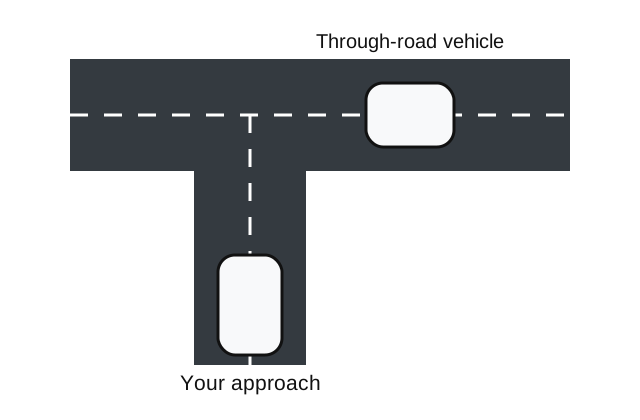
- The vehicle continuing along the through road. (correct): Correct: traffic continuing on the through road has priority.
- The vehicle entering from the ending road.: Entering from the terminating road does not displace through traffic.
- Whichever vehicle is moving faster.: Speed does not assign right-of-way.
At an unsigned T-intersection, traffic on the through road has right-of-way.
Source: California Driver’s Handbook, Section 7: Laws and Rules of the Road — Section 7, Right-of-Way Rules / Intersections / T intersections
You are stopped and want to turn left. An oncoming vehicle is close enough to be a hazard. What should you do?
- Begin the turn because left-turning traffic has priority after stopping.: Stopping first does not give a left turn priority over close oncoming traffic.
- Wait and yield until the oncoming vehicle has passed or turned. (correct): Correct: wait until the conflict clears.
- Move into the intersection and expect the oncoming driver to stop.: Do not assume another driver will yield or force a conflict.
A left-turning driver must yield to an approaching vehicle close enough to be dangerous, as well as pedestrians.
Source: California Driver’s Handbook, Section 7: Laws and Rules of the Road — Section 7, Right-of-Way Rules / Intersections / Turning left
You have a green light, but pedestrians are still crossing in front of your path. What should you do?
- Proceed because the green light controls pedestrians too.: A green light does not cancel pedestrian priority.
- Sound your horn and drive behind them.: The horn is not a substitute for yielding.
- Wait and let them clear your path. (correct): Correct: wait until the path is clear.
A green signal allows cautious progress but does not remove the pedestrian’s right-of-way.
Source: California Driver’s Handbook, Section 7: Laws and Rules of the Road — Section 7, Right-of-Way Rules / Intersections / Green traffic signal
You enter a roundabout approach while another vehicle is already circulating. What is your first priority?
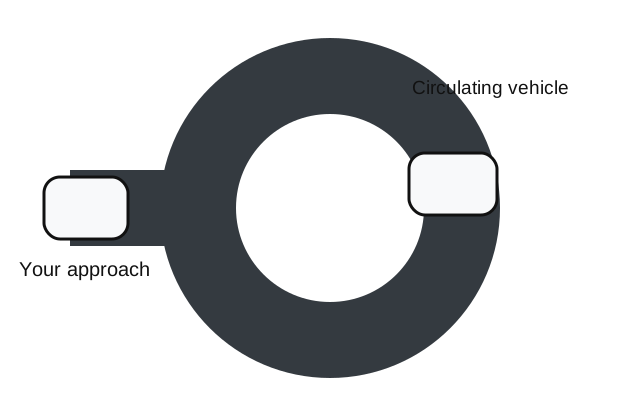
- Yield to circulating traffic and enter when a safe gap opens. (correct): Correct: wait outside for a safe opening.
- Enter first because approaching traffic has priority.: Traffic already in the roundabout has priority.
- Stop inside the roundabout to let the other vehicle exit.: Do not stop or obstruct traffic inside the roundabout.
Drivers approaching a roundabout yield to vehicles already in it, then merge when a safe opening is available.
Source: California Driver’s Handbook, Section 7: Laws and Rules of the Road — Section 7, Right-of-Way Rules / Roundabouts / approach and entry
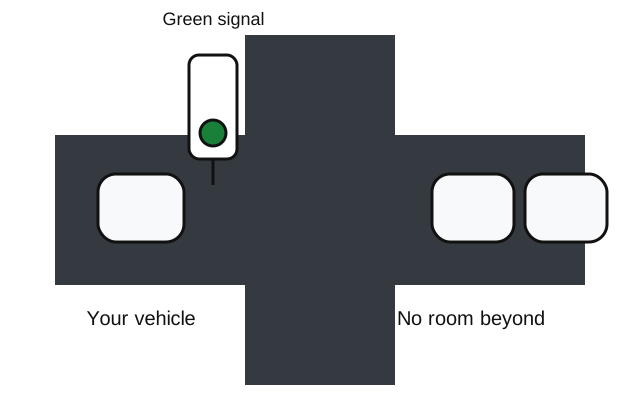
Traffic ahead is stopped beyond an intersection, leaving no room for your car on the far side. Your light is green. What should you do?
- Enter and wait in the crosswalk area.: Waiting in the crosswalk blocks pedestrian space.
- Stay behind the intersection until you can clear it. (correct): Correct: wait until there is space to cross fully.
- Follow the vehicle ahead into the intersection and stop there.: Following another vehicle does not make blocking lawful or safe.
Do not enter when congestion would leave you blocking the intersection as the signal changes.
Source: California Driver’s Handbook, Section 7: Laws and Rules of the Road — Section 7, Right-of-Way Rules / Intersections / Entering traffic
At a blind intersection, a parked van blocks your view. How should you approach?
- Maintain speed and rely on other road users to yield.: Blocked sightlines require added caution, not unchanged speed.
- Sound your horn and enter without checking.: A horn does not replace checking for cross traffic.
- Move forward slowly until you can see, prepared to stop. (correct): Correct: creep forward cautiously and be ready to stop.
When visibility is blocked at a blind intersection, move slowly forward until you can see.
Source: California Driver’s Handbook, Section 7 continued: Laws and Rules of the Road — Section 7 continued / Blind Intersections
You approach a marked crosswalk where a pedestrian is crossing. What must you do?
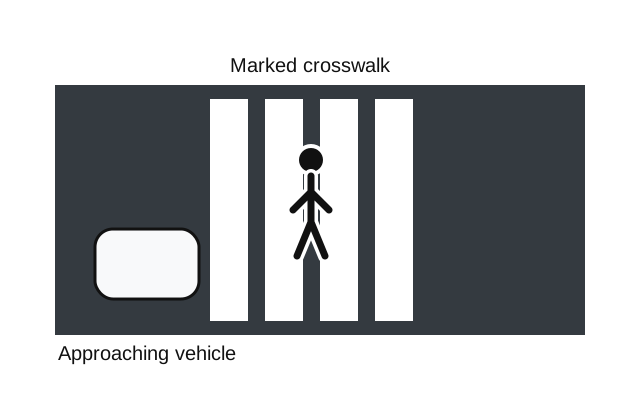
- Yield and stop before the crosswalk or limit line as needed. (correct): Correct: yield and keep the crosswalk clear.
- Continue if the pedestrian is in the opposite half of the road.: The far half of the crosswalk is still within the pedestrian’s crossing.
- Drive around the pedestrian through the opposing lane.: Do not drive around a person in a crosswalk.
Pedestrians have priority in marked and unmarked crosswalks; stop before the crosswalk or limit line and allow them across.
Source: California Driver’s Handbook, Section 7: Laws and Rules of the Road — Section 7, Right-of-Way Rules / Crosswalks
A person using a white cane steps into a crosswalk as you prepare to turn. What is the appropriate response?
- Honk briefly so the person knows your vehicle is waiting.: The handbook specifically says not to honk at a blind pedestrian.
- Stop and allow the person to cross without pressure or disturbance. (correct): Correct: remain stopped and leave the crossing clear.
- Turn behind the person before they reach your lane.: The person has priority across the crosswalk; do not turn through their path.
A pedestrian using a white cane has the right-of-way; do not honk at them or stop in the crosswalk.
Source: California Driver’s Handbook, Section 7: Laws and Rules of the Road — Section 7, Right-of-Way Rules / Pedestrians who are Blind
Lanes, markings and turning
You need to turn right at the next street. A bike lane reaches the intersection and no separate turn lane is available. When may you enter the bike lane?
- At any point once you signal.: Signaling alone does not authorize earlier use.
- Only after crossing the intersection.: The lane is used before the turn when needed; waiting until after misses the turn.
- Within 200 feet of the turn, after checking for bicyclists. (correct): Correct: enter within the specified approach distance and check carefully.
The handbook permits using a bike lane within 200 feet before a right turn. Check blind spots for bicyclists.
Source: California Driver’s Handbook, Section 6: Navigating the Roads — Section 6, Turns / Right Turns / bicycle lane
You are driving on a two-way road and plan to turn left at a business ahead. When may you use the center left-turn lane to prepare for that turn?
- Within 200 feet of the turn, after checking for traffic already in the lane. (correct): Correct: enter near the turn, look for lane traffic, and stay within the 200-foot limit.
- As soon as you see the business, even if it is several blocks away.: The center left-turn lane is not a place to wait or travel for several blocks.
- Only after you have crossed the opposing traffic lane at the driveway entrance.: This describes leaving a driveway, not preparing for a left turn from the road.
Use the center left-turn lane only to prepare for the turn, and travel no more than 200 feet in it. Check for other users in the lane before entering.
Source: California Driver’s Handbook, Section 6: Navigating the Roads — Section 6, Types of Lanes / Center Left Turn Lanes
A solid line separates your lane from the lane you need for an upcoming exit. What should you do?
- Cross immediately because your exit is close.: A desired exit does not make crossing a solid line appropriate.
- Wait until you can change lanes without crossing the solid line. (correct): Correct: do not cross the solid line; take a safe legal route.
- Stop in your lane until the solid line ends.: Stopping in a travel lane creates danger; no such instruction is given.
The handbook says not to cross solid lines when merging or exiting. Continue safely and use the next opportunity.
Source: California Driver’s Handbook, Section 6: Navigating the Roads — Section 6, Merging and Exiting / Exiting
On a two-way road, you prepare for a left turn. Which lane position is appropriate before turning?
- The far-right lane, then cut across at the intersection.: Starting at the right edge creates a crossing path through traffic.
- Any lane, because turn position does not matter.: Lane choice matters for predictable, safe turning.
- The lane nearest the center of the road or designated left-turn lane. (correct): Correct: position near the center or in the designated lane.
For a left turn, move near the center divider or into the left-turn lane, entering at its opening and not crossing a solid line.
Source: California Driver’s Handbook, Section 6: Navigating the Roads — Section 6, Turns / Left Turns
You make an ordinary right turn onto a road with multiple lanes and no markings permitting a wider turn. Where should you finish?
- In the lane nearest the right edge. (correct): Correct: complete the turn in the right lane.
- In whichever lane has the least traffic.: Choosing a distant lane can cut across traffic.
- Across the center line so the turn is shorter.: Crossing the center line puts you into opposing traffic.
An ordinary right turn begins and ends in the lane nearest the right edge; do not turn wide.
Source: California Driver’s Handbook, Section 6: Navigating the Roads — Section 6, Examples of Turns / Right turn
You are entering a freeway from an on-ramp. A solid line still separates you from the freeway lane. What should you do?
- Cross the line because freeway traffic must make room.: Freeway traffic has priority and the solid-line restriction remains.
- Continue in the ramp lane until you can merge without crossing the solid line. (correct): Correct: wait for a permitted opening and merge safely.
- Stop on the ramp until a driver waves you in.: Stopping is only necessary if absolutely required; a wave is not the rule.
Merge when safe, but do not cross a solid line. Highway traffic has right-of-way; do not depend on a wave.
Source: California Driver’s Handbook, Section 6: Navigating the Roads — Section 6, Merging / solid lines and yielding
In a multi-lane roundabout, you plan to go straight. Which lane rule does the handbook give?
- Enter the left lane and exit from the right lane.: The described lane crossing is not the straight-through guidance.
- Change lanes inside the circle to get ahead.: Do not pass or make unnecessary lane changes in the circle.
- You may choose either lane and exit in the same lane you entered. (correct): Correct: keep your entry lane through the exit.
For going straight in a multi-lane roundabout, the handbook allows either entry lane but directs you to exit in that lane.
Source: California Driver’s Handbook, Section 7: Laws and Rules of the Road — Section 7, Roundabouts / multiple-lane lane choice
A bicyclist ahead moves left around a pothole. How should you interpret that movement?
- The bicyclist may move left to avoid a roadway hazard. (correct): Correct: anticipate the hazard avoidance and do not crowd the rider.
- The bicyclist must stay at the curb regardless of hazards.: The handbook allows moving left to avoid hazards.
- The bicyclist is signaling that cars should pass on the right.: A move to avoid a pothole is not a pass signal.
California’s handbook recognizes bicyclists may move left to avoid hazards; expect that movement and give room.
Source: California Driver’s Handbook, Section 7 continued: Laws and Rules of the Road — Section 7 continued / Bicycles / rights
You missed your exit in a roundabout. What is the proper response?
- Stop in the circle and reverse toward the exit.: Stopping or reversing disrupts one-way circulation.
- Continue around and take the exit on the next pass. (correct): Correct: stay moving with the roundabout flow and try again.
- Cut across the center island.: The central island is not a travel lane.
If you miss the exit, continue circulating until you return to it.
Source: California Driver’s Handbook, Section 7: Laws and Rules of the Road — Section 7, Roundabouts / missed exit
At a freeway split, the lane markings guide one lane toward an exit. You want to remain on the main route. What is the best choice?
- Wait until the gore area, then cross the painted separation.: Crossing the gore/solid separation is unsafe and not an appropriate late maneuver.
- Brake to a stop at the split and decide there.: Stopping at a freeway split creates a hazard.
- Read the markings early and move to a through lane when a safe legal opening is available. (correct): Correct: choose the through lane before the split using a legal gap.
Planning ahead, changing lanes one at a time and respecting solid lines helps avoid last-second crossings.
Source: California Driver’s Handbook, Section 6: Navigating the Roads — Section 6, Merging and Exiting / planning and solid lines
Speed and following space
The posted limit is 45 mph, but heavy rain reduces traction and visibility. How fast should you travel?
- At a speed safe for the wet conditions, which may be below 45 mph. (correct): Correct: reduce speed as conditions require.
- At exactly 45 mph because the sign controls in all conditions.: The posted limit does not override the Basic Speed Law.
- At the speed of the fastest nearby driver.: Other drivers’ speed does not determine what is safe for you.
California’s Basic Speed Law prohibits driving faster than is safe for current conditions; a posted limit is not a requirement to maintain that speed.
Source: California Driver’s Handbook, Section 8 continued: Safe Driving — Section 8 continued / Manage Your Speed / Basic Speed Law
A clear road is ahead and the speedometer shows a lawful pace. What following-distance method does the handbook recommend to help prevent tailgating?
- Stay one car length behind at every speed.: A fixed car length does not account for speed.
- Keep at least three seconds behind the vehicle ahead. (correct): Correct: use at least three seconds as the basic following-space guide.
- Follow close enough that no vehicle can merge in front.: Closing the gap removes reaction space and is unsafe.
The handbook recommends the three-second rule to allow time to react and reduce tailgating risk.
Source: California Driver’s Handbook, Section 8: Safe Driving — Section 8, Tailgating / three-second rule
A car merges sharply into your lane, leaving little space. What should you do first?
- Accelerate to pass it immediately.: Accelerating can intensify the conflict and is not the stated response.
- Brake hard without checking behind you.: Abrupt braking without regard for traffic behind can cause a collision.
- Ease off the accelerator to rebuild a safe gap. (correct): Correct: smoothly create more following distance.
The handbook advises taking your foot off the accelerator when a vehicle merges too closely, creating space.
Source: California Driver’s Handbook, Section 8: Safe Driving — Section 8, Tailgating / vehicle merges in front
A driver behind you is following too closely. What is the safer approach?
- Keep a steady course and speed, then move right when safe to let them pass. (correct): Correct: avoid sudden maneuvers and let the driver pass when safe.
- Brake suddenly to warn the driver.: Sudden braking can trigger a rear-end collision.
- Speed up beyond the safe pace to create distance.: Do not exceed a safe speed to manage someone else’s behavior.
The handbook advises maintaining course and speed, then changing lanes to the right when safe to let a tailgater pass.
Source: California Driver’s Handbook, Section 8: Safe Driving — Section 8, Tailgating / tailgater behind
You are driving on a narrow road with pedestrians near the edge. What determines a safe speed?
- Only the posted number.: The posted limit does not make an unsafe speed safe.
- The conditions, including width, traffic and people nearby. (correct): Correct: adapt speed to conditions.
- The speed used by a vehicle behind you.: Pressure from following traffic does not set your safe speed.
The Basic Speed Law requires a pace safe for current conditions, including road width, traffic, pedestrians and weather.
Source: California Driver’s Handbook, Section 8 continued: Safe Driving — Section 8 continued / Manage Your Speed / factors
You are traveling on a two-lane undivided highway with no different posted limit. What maximum statutory limit does the handbook summarize for this road type?
- 65 mph.: 65 mph is the general maximum on most highways, not this category.
- 70 mph.: 70 mph is not the handbook’s default for this road type.
- 55 mph. (correct): Correct: the general maximum on this road type is 55 mph unless posted otherwise.
The handbook states 55 mph on a two-lane undivided highway unless otherwise posted, while actual safe speed may be lower.
Source: California Driver’s Handbook, Section 8 continued: Safe Driving — Section 8 continued / Manage Your Speed / limits
A freeway driver ahead brakes unexpectedly. What does a three-second gap give you?
- More time and distance to react to a sudden change. (correct): Correct: a gap adds reaction time.
- A guarantee that no collision can occur.: No following-distance method guarantees safety.
- Permission to look away because the gap is adequate.: Drivers still need to scan and attend to the roadway.
Following space creates time to notice and respond; it cannot guarantee a collision will never happen.
Source: California Driver’s Handbook, Section 8: Safe Driving — Section 8, Tailgating / three-second rule
A large vehicle blocks your view of traffic farther ahead. What should you do?
- Move closer to see around it.: Moving closer further restricts your view and time to react.
- Increase following space so you can see and react sooner. (correct): Correct: preserve visibility and reaction space.
- Stay alongside it in its blind spot.: The handbook advises not staying in another driver’s blind spot.
Tailgating reduces the view ahead; maintain enough space and avoid staying in another vehicle’s blind spot.
Source: California Driver’s Handbook, Section 8: Safe Driving — Section 8, Tailgating / side-space awareness
A freeway lane is slowing and another lane appears faster. What does the handbook say to avoid?
- Maintaining a steady lane when safe.: Steady, predictable travel is not weaving.
- Increasing following space.: A larger gap supports safer driving.
- Weaving in and out of freeway lanes to chase faster traffic. (correct): Correct: avoid weaving for small speed gains.
The handbook says to avoid weaving among freeway lanes; congestion can worsen with small changes in driving habits.
Source: California Driver’s Handbook, Section 8 continued: Safe Driving — Section 8 continued / Manage Your Speed / traffic congestion
You are approaching a curve where you cannot see the road beyond it. What should you do with your speed?
- Slow to a pace that lets you manage the unseen roadway safely. (correct): Correct: adjust before entering and be able to respond to what you cannot yet see.
- Maintain the limit because the curve is familiar.: Familiarity does not remove the unseen hazard.
- Accelerate before entering so you spend less time in the curve.: Higher speed reduces time to react.
Speed should account for visibility, road layout and hazards; the Basic Speed Law applies even below a posted limit.
Source: California Driver’s Handbook, Section 8 continued: Safe Driving — Section 8 continued / Manage Your Speed / conditions
Sharing the road
A bicyclist is riding ahead on a narrow roadway. You cannot leave at least three feet to pass because of oncoming traffic. What should you do?
- Squeeze between the bicyclist and the oncoming vehicle.: That forces the bicyclist into a dangerous narrow gap.
- Wait behind until the opposing vehicle passes, then pass with at least three feet. (correct): Correct: wait, then pass with the stated clearance.
- Use the horn and pass within the same narrow gap.: The horn does not create safe passing space.
When hazards are on both sides, handle one at a time: slow and let oncoming traffic pass, then leave at least three feet when passing the bicyclist.
Source: California Driver’s Handbook, Section 8 continued: Safe Driving — Section 8 continued / Choose Between Hazards / bicyclist
You are turning right and a bicyclist is traveling beside you near the curb. What should you do?
- Turn first because the car is already in the intersection.: Being positioned at the intersection does not justify crossing the rider’s path.
- Accelerate to get ahead of the bicycle.: Speeding ahead can create a conflict.
- Check the side and blind spot, then yield before turning across the bicyclist’s path. (correct): Correct: yield to the adjacent bicyclist before turning.
Drivers turning right must check for bicycles and motorcycles traveling beside them and avoid cutting across their path.
Source: California Driver’s Handbook, Section 7: Laws and Rules of the Road — Section 7, Right-of-Way Rules / Turning right
A motorcycle is ahead of you on a metal bridge surface. What following adjustment is recommended?
- Increase following space because the surface can reduce traction. (correct): Correct: leave added space on the slippery surface.
- Follow closer so you can pass before the bridge ends.: Close following leaves too little room to react.
- Drive alongside the motorcycle across the bridge.: Driving alongside reduces maneuvering room.
The handbook advises creating more space when following motorcyclists on metal surfaces and gravel.
Source: California Driver’s Handbook, Section 8: Safe Driving — Section 8, Tailgating / following motorcyclists on metal or gravel
A bicyclist ahead signals and moves left to prepare for a turn. How should you respond?
- Assume the rider must stay at the curb.: The handbook permits bicyclists to move left when turning.
- Recognize the rider may use the lane to turn; wait and avoid crowding. (correct): Correct: allow the rider to position for the turn.
- Pass on the right while the rider is moving left.: Passing on the right during the maneuver risks conflict.
Bicyclists make turns using lanes and may move left for a turn or hazard; give them room and respect their path.
Source: California Driver’s Handbook, Section 7 continued: Laws and Rules of the Road — Section 7 continued / Bicycles / left-turn positioning
A large truck is traveling ahead in the next lane. Which position should you avoid?
- Leaving room and passing only when there is a clear opportunity.: Leaving space and waiting for a safe chance to pass reduces time alongside the truck; this is not the position to avoid.
- Checking mirrors and blind spots before a lane change.: Checking before a maneuver is a safe practice, not the risky position.
- Staying alongside in the truck driver’s blind spot. (correct): Correct: do not linger beside the truck.
Large vehicles have blind areas; avoid remaining beside them and pass only when it can be done safely.
Source: California Driver’s Handbook, Section 8: Safe Driving — Section 8, Know What is At Your Side / blind spots
You approach a stationary emergency vehicle with flashing emergency lights. What should you do?
- Move over when safe and slow down as you pass. (correct): Correct: move over when it is safe and slow down.
- Maintain speed because the vehicle is off the travel lane.: The shoulder activity is covered by the handbook guidance.
- Stop immediately in your lane.: Stopping in a travel lane can create a hazard; the handbook says move over and slow down.
The handbook directs drivers to move over and slow down when approaching specified stationary emergency and road-work vehicles with warning lights.
Source: California Driver’s Handbook, Section 7 continued: Laws and Rules of the Road — Section 7 continued / Move Over and Slow Down
A horse and rider are near the roadway, and the animal appears uneasy. What should you do?
- Rev the engine to encourage the horse to move away.: Intentionally scaring an animal is prohibited and could cause a dangerous reaction.
- Slow down or stop and proceed when safe, following the handler’s directions. (correct): Correct: reduce the risk and follow the handler’s directions.
- Drive close behind the horse so it keeps moving.: Following closely can startle the animal and gives little room.
The handbook advises slowing or stopping for animals near the road, proceeding when safe, and following the handler’s directions; it also prohibits intentionally scaring horses or livestock.
Source: California Driver’s Handbook, Section 7 continued: Laws and Rules of the Road — Section 7 continued / Near Animals / horses and livestock
You see a pedestrian using a mobility wheelchair approaching the crosswalk while you plan a right turn. What should you do?
- Turn because the person is not walking on foot.: A wheelchair user is included as a pedestrian.
- Use the horn to ask the person to wait.: A horn does not replace yielding and may startle or pressure the person.
- Yield and wait until the person has safely crossed your path. (correct): Correct: wait and leave the crossing clear.
The handbook includes wheelchair users among pedestrians/vulnerable road users and gives pedestrians priority at crosswalks.
Source: California Driver’s Handbook, Section 7: Laws and Rules of the Road — Section 7, Right-of-Way Rules / Pedestrians
A vehicle is waiting to enter the freeway from the ramp beside you. If you have room and can do so safely, what can help?
- Make space for the entering vehicle. (correct): Correct: create room when safe.
- Speed up to close the gap.: Closing the gap removes the entering vehicle’s opportunity.
- Move into another lane without checking.: A lane change requires checking and a safe opening.
The handbook advises making space for vehicles entering freeways, while remaining alert and making any lane change only when safe.
Source: California Driver’s Handbook, Section 8: Safe Driving — Section 8, Know What is At Your Side / freeway entrants
At night, you approach a bicyclist whose bicycle has a front white lamp and rear red light. What should you remember?
- The lights mean the bicycle has priority over all vehicles.: Lights do not give the bicycle universal priority.
- The rider is a vulnerable road user; leave space and pass safely. (correct): Correct: visibility does not eliminate the need for safe passing distance.
- The lights allow you to pass without checking.: You remain responsible for checking before passing.
Lighting helps visibility but does not change right-of-way; drivers should still give cyclists space and pass only safely.
Source: California Driver’s Handbook, Section 7 continued: Laws and Rules of the Road — Section 7 continued / Bicycles / Bicycling at Night
Stopping and parking
You park facing uphill beside a curb. Which way should the front wheels point?
- Toward the curb.: This is the downhill-with-curb direction.
- Straight ahead in every case.: Wheel direction depends on slope and curb, not one universal straight position.
- Away from the curb. (correct): Correct: point away from the curb when facing uphill beside one.
When parked uphill beside a curb, turn the wheels away from the curb so the vehicle would roll toward it if it moved.
Source: California Driver’s Handbook, Section 6 continued: Navigating the Roads — Section 6 continued / Parking on a Hill / uphill with curb
You park facing downhill on a street with a curb. How should you position the front wheels?
- Toward the curb. (correct): Correct: direct the front wheels toward the curb.
- Away from the curb.: Away from the curb is the uphill-with-curb direction.
- Straight ahead, then rely only on the parking brake.: The handbook pairs wheel positioning with the parking brake.
For downhill parking beside a curb, turn the wheels toward the curb and set the parking brake.
Source: California Driver’s Handbook, Section 6 continued: Navigating the Roads — Section 6 continued / Parking on a Hill / downhill with curb
You stop behind another vehicle at a limit line. What position leaves a useful safety margin?
- Roll over the line so the next driver can see you.: Crossing the line intrudes into the protected area.
- Stop before the line and leave enough room to see the vehicle’s rear wheels. (correct): Correct: remain behind the line and preserve space.
- Stop so close that your bumper touches the vehicle ahead.: Contact distance gives no room to maneuver.
Do not cross a limit line; when stopping behind a vehicle, leave enough distance to see its rear wheels.
Source: California Driver’s Handbook, Section 6: Navigating the Roads — Section 6, Braking / stopping at a limit line and behind a vehicle
You are looking for a parallel-parking space. What minimum extra length over your vehicle does the handbook suggest seeking?
- About six inches.: Six inches leaves inadequate room for the parking maneuver.
- Exactly the length of your vehicle.: A space equal to vehicle length provides no maneuvering room.
- About three feet. (correct): Correct: allow roughly three extra feet.
The handbook’s parallel-parking instructions recommend a space at least three feet longer than your vehicle.
Source: California Driver’s Handbook, Section 6 continued: Navigating the Roads — Section 6 continued / Parallel Parking / finding a space
You find an unoccupied blue-painted curb. Which conclusion should guide your parking decision?
- The space is reserved for a vehicle displaying the required disabled-person placard or plate. (correct): Correct: use the space only when the required disabled-parking display is present and applicable conditions are met.
- An empty space may be used by any driver until someone else arrives.: Being unoccupied does not remove the blue-curb restriction.
- A vehicle may use the space for commercial loading whenever it is unoccupied.: A blue curb does not designate commercial loading.
A blue curb marks parking reserved for eligible disabled-person placard or plate display, subject to posted rules. An open space does not make it general parking or a loading zone.
Source: California Driver’s Handbook, Section 6 continued: Navigating the Roads — Section 6 continued / Stopping, Parking, and Special Parking Rules / blue curb
Your car stalls on a freeway. Which action should you take first if you can do so safely?
- Stop in the nearest travel lane and exit on the traffic side.: Stopping in a live lane increases danger.
- Pull completely onto the right shoulder. (correct): Correct: get fully out of the travel lane if safe.
- Reverse along the shoulder to the last exit.: Reversing on a freeway is unsafe and not the guidance.
The handbook says to safely pull to the right shoulder; if leaving the vehicle is necessary, exit on the right side away from traffic.
Source: California Driver’s Handbook, Section 8 continued: Safe Driving — Section 8 continued / If Your Vehicle Becomes Disabled on the Freeway
A railroad crossing has flashing warning lights and your vehicle becomes stuck on the tracks with a train approaching. What should you do?
- Stay in the car and call roadside assistance.: Staying in the vehicle exposes occupants to immediate danger.
- Push the vehicle toward the tracks to clear the roadway.: Do not move toward the train or remain on the tracks.
- Get out immediately, move diagonally away in the direction the train is coming from, and call 911. (correct): Correct: evacuate away from the tracks and alert emergency services.
With a train approaching and warning lights flashing, leave immediately, move diagonally away from the tracks toward the train’s approach direction, then call 911.
Source: California Driver’s Handbook, Section 8 continued: Safe Driving — Section 8 continued / Disabled Vehicles on Railroad Tracks / train approaching
A vehicle ahead stops at a crosswalk to let a pedestrian pass. What should you avoid doing?
- Passing around it into the crosswalk or adjacent lane. (correct): Correct: do not overtake a vehicle stopped at the crossing.
- Waiting until the pedestrian has cleared and the path is safe.: Waiting is the safe response.
- Stopping with space behind the vehicle.: Leaving a gap provides room and visibility.
Do not pass a vehicle stopped at a crosswalk; it may be yielding to a pedestrian you cannot see.
Source: California Driver’s Handbook, Section 7: Laws and Rules of the Road — Section 7, Right-of-Way Rules / Crosswalks
You have to stop briefly on a freeway because your vehicle is disabled. Which position and action does the handbook recommend?
- Remain partly in the lane with the door open.: Partly blocking a lane exposes you and traffic to danger.
- Get fully off the pavement and stay in the vehicle with doors locked until help arrives, unless a safer refuge requires leaving. (correct): Correct: use the shoulder and remain protected unless conditions make that unsafe.
- Walk along the freeway to find a gas station.: Walking alongside freeway traffic is not the stated recommendation.
For a freeway stop, the handbook advises parking completely off pavement and staying inside with doors locked until help arrives; specific dangerous shoulder circumstances may make a safer area preferable.
Source: California Driver’s Handbook, Section 6 continued: Navigating the Roads — Section 6 continued / Parking / stopping on a freeway
You are parallel parking behind a vehicle. Which setup matches the handbook’s initial positioning guidance?
- Stop several feet behind the open space and drive forward into it.: This does not follow the described starting position.
- Pull alongside the rear vehicle and turn sharply without checking.: Starting beside the rear vehicle risks clipping it and omits checks.
- Pull alongside the vehicle in front of the open space, leaving about two feet, then begin the maneuver. (correct): Correct: begin beside the vehicle ahead with room to maneuver.
The handbook’s parking sequence begins alongside the vehicle in front of the space with about two feet between vehicles, then proceeds into the space.
Source: California Driver’s Handbook, Section 6 continued: Navigating the Roads — Section 6 continued / Parallel Parking / positioning
Official sources and limits
These official handbook pages are factual references for the original questions. Retrieval dates do not establish individual rules’ legal effective dates. This bank did not receive a separate Vehicle Code or effective-amendment audit. Check current official guidance before relying on a rule.
- California Driver’s Handbook, Section 7: Laws and Rules of the Road — consulted 2026-11-01
- California Driver’s Handbook, Section 7 continued: Laws and Rules of the Road — consulted 2026-11-01
- California Driver’s Handbook, Section 6: Navigating the Roads — consulted 2026-11-02
- California Driver’s Handbook, Section 6 continued: Navigating the Roads — consulted 2026-11-02
- California Driver’s Handbook, Section 8: Safe Driving — consulted 2026-11-02
- California Driver’s Handbook, Section 8 continued: Safe Driving — consulted 2026-11-01