SUPPLEMENTAL PRACTICE
Original unofficial supplemental California sign practice. This is not an official DMV test or a prediction of your result. The image descriptions provide a text study alternative; this has not been assessed as an equivalent nonvisual test.
Visual sign practice
Interactive practice requires JavaScript. Study the questions, answers and sources below.
Study all five questions, answers and sources
Source retrieval dates are observations, not rule-effective dates.
You approach an intersection with this sign. A painted limit line is before the crosswalk on your side. Where should you stop?

- At the painted limit line, before the crosswalk. (correct): Correct. The marked limit line gives the stopping point in this scenario.
- Past the limit line, as long as you stop before the crosswalk.: Incorrect. The vehicle would pass the marked stopping point.
- Beyond the crosswalk, where you can see both directions.: Incorrect. A driver should not enter the crosswalk before stopping at the marked limit line.
When a limit line is marked, stop at it. Here it is before the crosswalk, so stopping there keeps the vehicle behind the crossing area. This image-based scenario reinforces a stop-sign concept in the accepted text bank; its marked-line condition differs from the existing no-line example.
Source: California Driver’s Handbook, Section 7: Laws and Rules of the Road — Signs > STOP Sign (retrieved 2026-11-02T21:58:31Z)
Source: CA MUTCD 2026, Chapter 2B — Regulatory Signs, Barricades, and Gates — §2B.04 STOP Sign (R1-1). (retrieved 2026-11-02T21:58:31Z)
You approach this sign at a junction. A bicyclist is already crossing the path you would enter. What should you do?
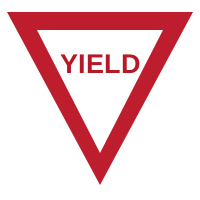
- Keep rolling because this sign only warns you to check for a cross street.: Incorrect. A yield sign controls right of way; it is not only a cross-street warning.
- Slow down, give the bicyclist room to pass, and stop if needed before proceeding. (correct): Correct. Let the bicyclist pass; stop if needed to yield safely.
- Stop once at the sign, then proceed even if the bicyclist is still in your path.: Incorrect. A stop at the sign does not grant permission to proceed into the bicyclist’s path.
A yield-controlled approach requires slowing and giving way to traffic or people who need to pass before you proceed. The bicyclist is already in your path, so wait until it is clear. The sign’s shape and color are presented visually; the scenario asks for a safe decision.
Source: California Driver’s Handbook, Section 7: Laws and Rules of the Road — Signs > Red YIELD Sign (retrieved 2026-11-02T21:58:31Z)
Source: CA MUTCD 2026, Chapter 2B — Regulatory Signs, Barricades, and Gates — §2B.05 YIELD Sign (R1-2). (retrieved 2026-11-02T21:58:31Z)
The sign shown faces drivers at the entrance to a ramp. The ramp looks empty. What should you do?
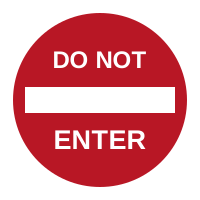
- Enter if no vehicle is visible.: Incorrect. The sign restriction applies even when no other vehicle is visible.
- Do not enter the road or ramp from this approach. (correct): Correct. Do not enter where this sign faces the approach.
- Enter only after coming to a complete stop.: Incorrect. Stopping first does not make entry permitted.
The red-and-white regulatory sign bars entry from the approach where it is posted. An empty-looking ramp does not remove that restriction.
Source: California Driver’s Handbook, Section 7: Laws and Rules of the Road — Signs > Red and White Regulatory Sign (retrieved 2026-11-02T21:58:31Z)
Source: CA MUTCD 2026, Chapter 2B — Regulatory Signs, Barricades, and Gates — §2B.46 DO NOT ENTER Sign (R5-1), especially paragraphs 1 and 6; Figure 2B-13. (retrieved 2026-11-02T21:58:31Z)
You realize you entered a one-way street in the wrong direction. This sign faces you. What is the safest response?
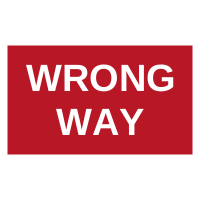
- Do not continue against the traffic direction; leave or turn around only when you can do so safely. (correct): Correct. Avoid continuing against traffic and choose a safe way to leave or turn around.
- Continue to the next intersection and wait there for traffic to clear.: Incorrect. Continuing farther against traffic extends the wrong-way movement.
- Make an immediate U-turn where you are, regardless of nearby traffic.: Incorrect. A turn is only appropriate when it can be made safely.
The sign warns that the vehicle is on a roadway against the intended traffic flow. Correct the direction safely; do not continue into opposing traffic or make an abrupt turn. The exact safe maneuver depends on the roadway and traffic conditions, so this item does not prescribe one maneuver for every location.
Source: California Driver’s Handbook, Section 7: Laws and Rules of the Road — Signs > WRONG WAY Sign (retrieved 2026-11-02T21:58:31Z)
Source: CA MUTCD 2026, Chapter 2B — Regulatory Signs, Barricades, and Gates — §2B.46 and Figure 2B-13, WRONG WAY sign (R5-1a) and placement of the paired DO NOT ENTER package. (retrieved 2026-11-02T21:58:31Z)
You are in a left-turn lane, and the pictured signal applies to your movement. No other sign or signal permits a turn on red. What should you do?

- Wait until an indication permits the left turn. (correct): Correct. The red left arrow means wait for an indication that permits the left turn.
- Turn left after stopping, as if this were a circular red signal.: Incorrect. The circular-red turn rule does not apply to this red arrow.
- Turn left when opposing traffic clears, even while the arrow stays red.: Incorrect. Clearing opposing traffic does not permit a turn against a red arrow.
A steady red arrow requires the indicated movement to wait until an indication or other control permits that movement. The scenario rules out a sign or signal exception. This is an explicitly labeled visual-recognition reinforcement of an accepted text-bank competency, not a new unique competency claim.
Source: California Driver’s Handbook, Section 7: Laws and Rules of the Road — Traffic Signals > Red Arrow (retrieved 2026-11-02T21:58:31Z)
Source: CA MUTCD 2026, Chapter 4A — General — §4A.03(01)(C)(2), steady RED ARROW signal indication. (retrieved 2026-11-02T21:58:31Z)